
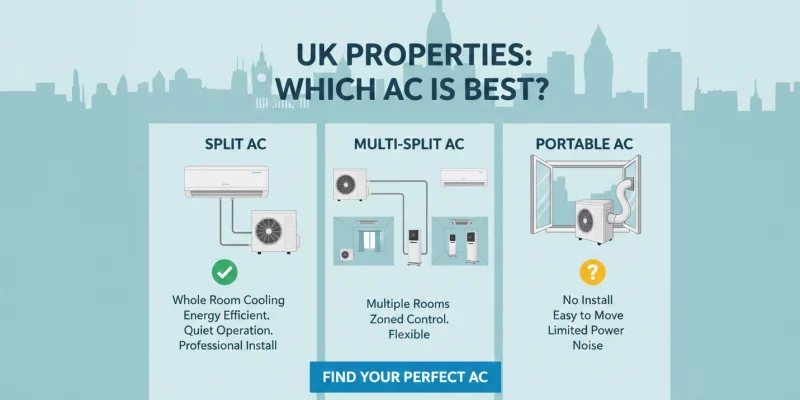
Split vs Multi-Split vs Portable AC: Which is Best for UK Properties?
Tossing and turning on a stuffy summer night, with a fan just blowing hot air around? You’re not alone. As UK summers get warmer, many of us are finding that a simple fan doesn’t cut it anymore. The problem is that our homes are built to trap heat—brilliant for nine months of the year, but tough during a heatwave.
Deciding if air conditioning is worth it starts with understanding your options. This guide covers the three main types you need to know: Portable, Split, and Multi-Split.
The Quick Fix: What to Know About Portable Air Conditioners
If you’re looking for immediate relief, a portable air conditioner is often the first option considered. These are freestanding units on wheels that you can simply plug into the wall. They are single-unit systems, meaning all the working parts are in the box with you. To cool your room, they pump captured heat away through a thick, flexible exhaust hose that must be positioned out of a slightly open window or door.
The main appeal is convenience and cost. There’s no professional installation needed; you can buy one from a DIY shop and have it running within minutes. They are also significantly cheaper to purchase upfront than installed systems. For tackling a sudden heatwave on a budget, their appeal is undeniable.
However, this convenience comes with serious trade-offs. Because all the machinery is in the room, portable units are noisy—often as loud as a vacuum cleaner. They are also less efficient. The open window for the exhaust hose lets warm air back in, and the unit itself generates some heat, forcing it to work harder and use more electricity to achieve the same cooling effect as other types.
A portable AC unit can be worth it for temporary relief in a single room where noise isn’t a dealbreaker, like a home office or a conservatory. But if you’re dreaming of a truly cool and quiet night’s sleep, you may find yourself disappointed.

The ‘Proper’ Solution: Why Split Systems are Quieter and More Efficient
For a permanent and peaceful solution, the answer is a split system air conditioner. The system is ‘split’ into two parts: a sleek indoor unit mounted high on a wall that blows the cool air, and a discreet outdoor unit that does the hard work of expelling the heat.
The key benefit of this design is the near-silent operation indoors. The outdoor unit contains all the noisiest components, including the compressor. Because this is located outside your home, the indoor unit just whispers cool air into the room. This makes it a perfect, quiet air conditioner for a bedroom, a nursery, or a home office where you need to concentrate.
Beyond quietness, the split design is also vastly more energy-efficient. Unlike a portable unit needing an open window, a split system is fully sealed. No warm air gets back in, so the unit doesn’t have to constantly fight to keep the temperature down, saving you significantly on electricity bills. While this type of system does require professional installation, its superior performance and low running costs make it the standard for long-term comfort in UK homes.

Cooling Your Whole Home: When Does a Multi-Split System Make Sense?
A quiet split system is perfect for one room, but what about cooling the master bedroom and a stuffy home office? This is where multi-split air conditioning systems come in. It’s the same principle, but a single, more powerful outdoor unit connects to several indoor units—usually between two and four. This setup avoids cluttering the outside of your home with multiple boxes.
This approach is ideal for creating cool zones in the most-used areas, like main bedrooms and the living room. Each indoor unit is controlled independently, letting you cool one room for sleeping without having to run the others. It’s a practical way to get the benefits of proper air conditioning in multiple rooms without a more complex whole-house solution.
The clearest benefit is visual. Instead of needing a separate box on your exterior wall for every room, you only need one. This keeps your property looking tidy and is often essential for flats or terraced houses where external space is tight.
The Real Cost of Cool: Upfront Installation vs. Running Costs
One of the biggest questions is the price. It’s crucial to think about two different figures: the initial cost to buy and install the unit, and the long-term cost to run it. Here’s a typical breakdown of what you can expect to pay upfront in the UK.
- Portable Unit: £300 – £700 (Plug in and go)
- Single Split System: £1,800 – £3,000 (Professionally installed)
- Multi-Split System (2 rooms): £3,500 – £5,000 (Professionally installed)
While a portable unit is cheaper to buy, an installed split system is dramatically cheaper to run. A power-hungry portable unit can cost 30-40p per hour, whereas a modern, efficient split system can cost as little as 5-10p per hour. That difference adds up quickly over a hot summer.
The secret to this efficiency is Inverter technology. Think of it like cruise control for your car; instead of blasting on and off at full power, it intelligently adjusts itself to maintain the temperature. This uses far less electricity and is much quieter. It’s a must-have feature for any energy-efficient air conditioning unit.
Ultimately, you pay more initially for an installed system, but you get lower running costs, quieter operation, and better cooling for years to come.
What Size Air Conditioner Do I Need? Decoding BTUs for UK Rooms
When choosing an air conditioner, you’ll see a rating called BTU (British Thermal Unit). This is simply a measure of cooling power—the higher the BTU number, the larger the space it can effectively cool. Getting this right is key to both comfort and efficiency.
As a rough guide for UK homes, a typical bedroom (around 15 sq m) will need a unit with about 5,000 BTUs. For a larger, south-facing living room (around 30 sq m), you’d be looking closer to 10,000 BTUs. A professional installer will do an exact calculation, but this gives you a general idea of the power you might need.
It might be tempting to buy a more powerful unit “just in case,” but this is a common mistake. An oversized unit will hit the target temperature too quickly and then shut off. This constant on-off cycle is inefficient and fails to properly remove humidity, leaving the room feeling cold and clammy rather than comfortably cool.
Do I Need Planning Permission for an Air Con Unit in the UK?
The question of planning permission for external air con units is a common one. For most houses, installing one is considered ‘Permitted Development,’ meaning you don’t need to apply for permission. As long as the outdoor unit isn’t on the front of your house and respects certain size and location rules, you are usually in the clear. A professional installer will be familiar with these standard requirements.
However, these rights don’t apply everywhere. If you live in a flat, you’ll need the freeholder’s permission. The rules for choosing an air conditioner for a listed building or a home in a Conservation Area are much stricter. In these situations, you will almost certainly need to seek formal consent before any work begins.
Finally, there are the mandatory F-Gas regulations for home air conditioning. These laws cover the specialist refrigerant gases inside the unit and dictate that any installation or service must be handled by an F-Gas certified engineer. This is not a DIY task; it is a legal requirement, so always check your installer’s credentials.
More Than Just Cooling: How Your AC Can Also Be an Efficient Heater
Modern split systems have a fantastic trick up their sleeve. With the press of a button, most can run in reverse, transforming into an air-to-air heat pump to warm your home during colder months. This isn’t a weak feature; it’s a powerful and efficient way to generate warmth.
Unlike a standard electric heater that creates heat from scratch, a heat pump cleverly moves existing warmth from the outside air into your room—even on a cold day. This process is remarkably energy efficient, often using three times less electricity than a portable fan heater to produce the same amount of warmth, making it one of the cheapest ways to heat a room.
This dual function transforms your air conditioner from a seasonal purchase into a year-round investment. It becomes a perfect alternative to central heating for quickly warming a chilly home office or taking the edge off in autumn without firing up the entire system.
Your Action Plan: Deciding on the Right Air Conditioning for Your Home
The choice in air conditioning is a trade-off between a quick, temporary fix and a quiet, permanent investment. To find the right path for your home, start by asking yourself these four key questions:
- Which rooms need cooling the most?
- What is my total budget (for the unit and installation)?
- How important is quiet operation for me and my neighbours?
- Do I own a house, rent a flat, or live in a listed building?
Armed with your answers, you are ready for the most important step: having a knowledgeable conversation with an AC installer. Contact two or three local, F-Gas registered professionals for a survey and quote to confidently reclaim your comfort from those sweltering summer days.